
How should a UAE business build its team in 2026? hire workers directly, bring in talent from abroad, or let an outside partner handle it all? More and more companies are choosing option three.
Workforce outsourcing in the UAE is changing fast, shaped by smart technology, new Emiratisation rules, and a steady stream of foreign firms opening offices in the country’s free zones. This guide walks through the nine biggest trends for 2026, the pitfalls to plan for, and how to pick a partner who helps your business grow.
What Workforce Outsourcing Looks Like in the UAE Today
Workforce outsourcing in the UAE has moved well beyond simply “supplying workers.” It now covers a range of service types, each built for a different need.
The main types of outsourcing
- Staffing and manpower supply: short-term or project-based hiring handled through licensed agencies.
- Business Process Outsourcing (BPO): passing whole functions like customer service, finance, or back-office work to an outside provider.
- Knowledge Process Outsourcing (KPO): outsourcing more skilled jobs such as research, analytics, and legal review.
- Employer of Record (EOR): a partner who legally employs your staff in the UAE while you manage their daily work. This is a favourite for foreign firms that don’t yet have a local office.
- Professional Employer Organisation (PEO): a shared employment setup where the provider takes care of HR, payroll, and compliance work for you.
Who uses these services
Three groups make up most of the demand: global companies testing the UAE market before opening their own office, fast-growing small and medium businesses that don’t want to build their own HR team, and large local employers passing non-essential operations to specialists.
The rules behind the system
UAE outsourcing works inside a strict set of rules. The Ministry of Human Resources and Emiratisation (MOHRE) oversees mainland employment. The Wage Protection System (WPS) makes sure salaries are paid through approved bank channels. Free zones such as DIFC, ADGM, and DMCC follow their own employment rules. Add the UAE’s Personal Data Protection Law (PDPL) on top, and outsourcing partners now need to know compliance just as well as recruitment.
Why 2026 Is a Turning Point
Three big forces are coming together this year, turning outsourcing into a strategic choice rather than just a way to save money.
UAE Vision 2031 and a wider economy
The drive to move beyond oil has boosted sectors like tourism, fintech, AI, clean energy, and advanced manufacturing. All of these need skilled people faster than traditional hiring can deliver.
Faster Emiratisation in the private sector
Private companies above a certain size must hire a growing share of UAE nationals each year, with money penalties for missing the target. Outsourcing providers who can find, train, and keep Emirati staff have become must-have partners not nice-to-have ones.
A growing shortage of specialist skills
AI engineers, cybersecurity experts, fintech compliance officers, ESG specialists, the UAE is fighting for these people on the global market, and outsourcing is often the quickest way to bring them on board.
9 Workforce Outsourcing Trends for 2026
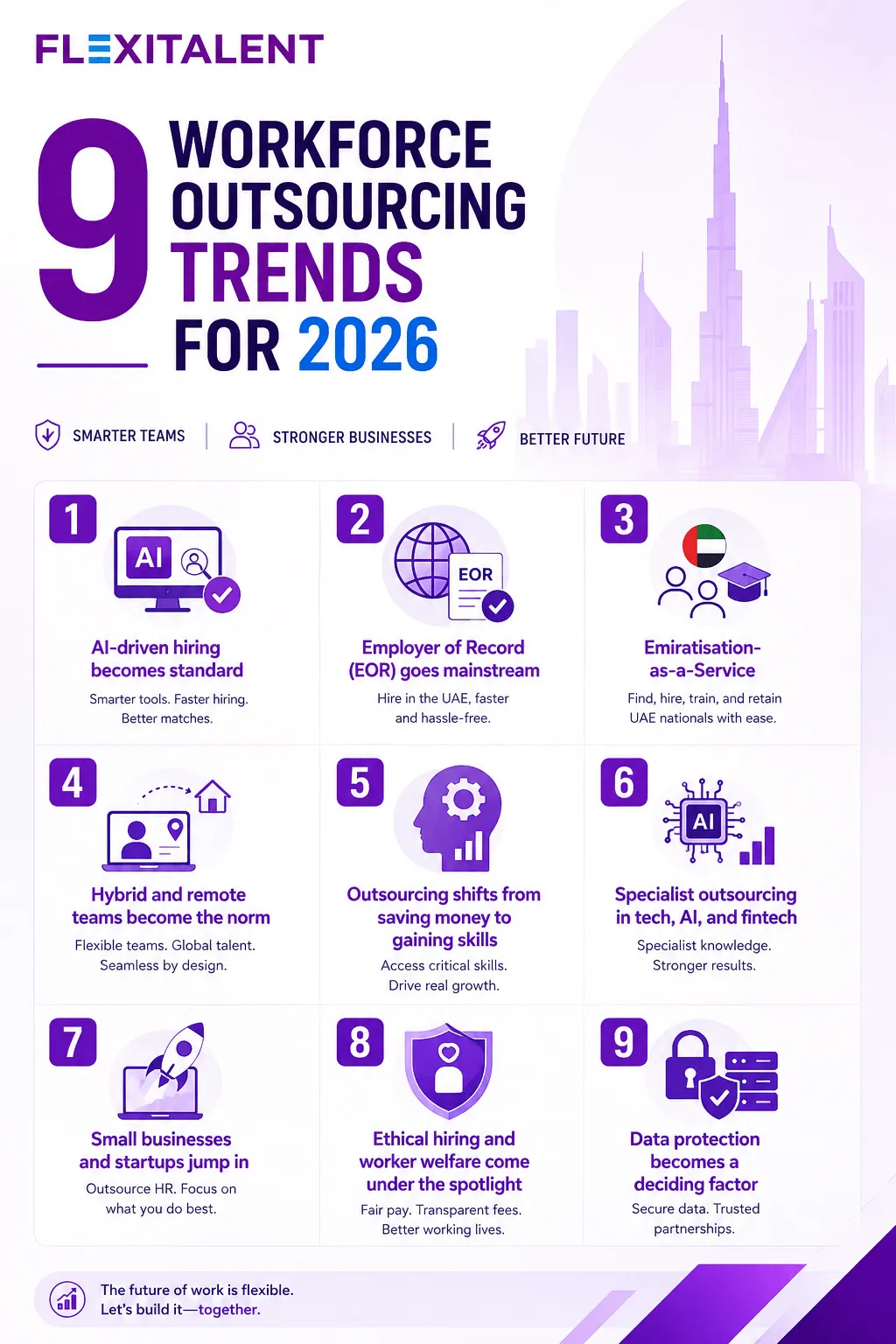
1. AI-driven hiring becomes standard
Agencies still reading CVs by hand are falling behind. Smart tools now find candidates, run early screening, score skills, set up interviews, and even predict who is most likely to succeed in a role. For clients, this means faster hiring and lower costs. For providers, it means investing in technology is no longer a choice.
2. Employer of Record (EOR) services go mainstream
Foreign companies wanting to test the UAE market without spending months opening a free-zone office and sorting out visa sponsorships are turning to EOR providers. Expect this model to become a standard way to enter the country in 2026, especially for tech, consulting, and software firms hiring small starter teams.
3. Emiratisation-as-a-Service
A new type of provider has appeared: specialists who help companies find, hire, train, and retain UAE nationals in line with national hiring rules. Look out for more partnerships between outsourcing firms, universities, and government-backed training programmes such as Nafis throughout 2026.
4. Hybrid and remote teams become the norm
Remote-work visas, freelance permits, and flexible free-zone licences have made spread-out teams much easier to manage legally than they were five years ago. Outsourcing partners now regularly build hybrid teams that mix on-site UAE staff with remote workers based elsewhere in the region or further afield.
5. Outsourcing shifts from saving money to gaining skills
The old idea “outsource to cut costs” is being replaced by a new one: “outsource to get skills we can’t build in-house in time.” This is especially true for AI, data engineering, cybersecurity, and ESG roles, where local talent simply hasn’t kept up with what businesses need.
6. Specialist outsourcing in tech, AI, and fintech
General staffing firms are losing ground to smaller, focused providers working in just one industry. A fintech startup in DIFC, for example, is more likely to use a fintech-only recruiter than a general agency because the specialist already knows the rules, the salary ranges, and the active pool of available talent.
7. Small businesses and startups jump in
Small firms that used to handle HR in-house are now outsourcing payroll, recruitment, and compliance work. The reason is simple: founders want to focus on their product and customers, not on WPS filings and visa renewals.
8. Ethical hiring and worker welfare come under the spotlight
Clients especially large global firms are pushing outsourcing partners to prove they pay workers fairly, charge transparent recruitment fees, and look after worker welfare properly. Expect more contracts in 2026 to include ethical hiring clauses and audit rights.
9. Data protection becomes a deciding factor
The UAE’s data protection law has changed how HR information moves between client and provider. Companies now ask providers about where data is stored, how it’s protected, how quickly they report breaches, and whether they hold certifications like ISO 27001 not just about price and headcount.
Sector Spotlights: Where Outsourcing Is Growing Fastest
Financial services and fintech
DIFC and ADGM keep drawing in global banks, investment firms, and fintech startups. Outsourcing demand here focuses on compliance, anti-money-laundering work, risk analysis, and software development.
Healthcare and life sciences
Hospitals, clinics, and pharmacy chains are outsourcing both medical support roles (nurses, lab technicians) and back-office tasks (billing, insurance claims, telehealth support).
Construction, real estate, and facilities management
Still a major employer in the UAE. Outsourcing here is moving toward better worker welfare, digital tools for managing teams, and skilled trades rather than just basic labour.
Retail, hospitality, and tourism
Busy periods – major events, sports tournaments, holiday peaks make flexible outsourced staffing especially useful.
Technology and digital services
Cloud engineers, DevOps experts, cybersecurity analysts, and AI specialists are in constant short supply. Outsourcing partners with strong regional and overseas networks have a real edge in this space.
Risks and Challenges to Plan For
Outsourcing in the UAE isn’t a quick fix. A few risks need real planning.
-
Complex rules and Emiratisation penalties
Missing your Emiratisation target can mean hefty fines. Make sure your outsourcing partner takes ownership of compliance, not just finding candidates.
-
Data protection and cross-border data transfers
If your provider moves HR or payroll data outside the UAE, you need a clear answer on the legal basis, the safeguards in place, and what they must tell you if something goes wrong.
-
Cultural and language fit
A candidate with strong technical skills who can’t navigate local business culture or doesn’t speak the language your customers use will struggle. Specialist providers handle this better than general ones.
-
Vendor lock-in and quality issues
Long contracts with vague service promises make it hard to switch providers if quality drops. Set clear exit terms and performance measures from day one.
-
Cybersecurity threats
HR and payroll information is a top target for cybercriminals. Insist on proof of security certifications, regular system testing, and a clear plan for handling a breach.
How to Pick the Right Outsourcing Partner in 2026
If you’re shortlisting providers this year, use this practical checklist.
- Proven UAE labour-law and Emiratisation know-how: Ask for examples of recent compliance work, MOHRE dealings, and Emiratisation hires they’ve handled.
- Their technology: What hiring software, payroll tools, and AI systems do they use? Can you see what’s happening in real time, or are you stuck waiting for email updates?
- Industry-specific experience: A provider who has placed 500 hospitality workers may not be the right choice for a fintech compliance hire. Ask for references from your specific industry.
- Clear pricing and service promises: Look past the headline rate. What’s included? What costs extra? What happens if someone doesn’t work out in the first 90 days?
- Data security credentials: ISO 27001 and SOC 2 are good basic signs. PDPL readiness is a must, not a nice-to-have.
Quick comparison: EOR vs PEO vs Staff Augmentation
| Type | Who legally employs the worker | Best for |
|---|---|---|
| EOR | The provider | Foreign companies entering the UAE without a local office |
| PEO | Shared between provider and client | Companies with a UAE office that want HR work taken off their plate |
| Staff augmentation | The provider or agency | Short-term project work and flexible scaling |
What’s Next Beyond 2026
Looking further ahead, three shifts are worth keeping an eye on:
- Teams that mix people and AI, where outsourcing contracts cover not just human workers but also the AI tools working with them.
- The UAE becoming a provider of outsourcing services, not just a buyer especially in fintech compliance, Arabic-language customer service, and Islamic finance specialisms.
- Tougher rules on ethical hiring and worker welfare that will reshape low-skilled outsourcing contracts in particular.
Companies that plan around these shifts in 2026 will be in a stronger position when the changes really pick up speed.
Frequently Asked Questions
Is workforce outsourcing legal in the UAE?
Yes. Outsourcing through licensed staffing agencies, EOR partners, and PEO providers is allowed, as long as the provider holds the right MOHRE or free-zone permits and follows the rules on labour, pay, and data protection.
What’s the difference between EOR and PEO in the UAE?
An EOR legally employs your team for you useful if you don’t have a UAE office. A PEO is a shared employment model useful if you already have a UAE office but want help running HR.
Does Emiratisation apply to outsourced staff?
This is one of the most-asked questions, and the answer depends on the contract setup, the size of the client company, and which company legally employs the worker. Check the current position directly with MOHRE or a qualified UAE employment lawyer before you finalise your workforce plan.
How much does outsourcing cost in the UAE?
Pricing varies a lot usually a percentage on top of salary for staff augmentation, a flat monthly fee per worker for EOR, or a fixed contract price for BPO. Always ask for a full cost breakdown including visas, insurance, end-of-service payments, and any one-off setup fees.
Can free-zone companies outsource mainland staff?
Yes, but it needs careful planning. Mainland and free-zone employment rules are different, and the outsourcing partner must hold the right permits to work across both.
Final Thoughts
The story of workforce outsourcing in the UAE in 2026 is less about cutting costs and more about gaining the right skills AI-supported hiring, Emiratisation compliance, foreign firms entering the market, and access to scarce specialist talent. Companies that treat outsourcing like a buying decision will keep getting buying-decision results. Those that treat it as a real partnership will move faster, hire smarter, and stay ahead of the rules.