The Gulf Cooperation Council (GCC) region is changing quickly. With bold national development plans, major global events, and large infrastructure projects in progress, businesses are under pressure to adapt fast.
To keep up, many companies are turning to temporary staffing. This approach allows them to expand their teams when needed, without making long-term hiring commitments. It’s especially useful for handling seasonal peaks, managing big projects, and reducing costs, all while following local labor rules.
Looking ahead, temporary staffing in the GCC will continue to grow and change. Advances in technology, updated labor laws, and new market demands will shape how businesses hire and manage short-term workers in the coming years.
Current Landscape of Temporary Staffing in the GCC
Temporary staffing has become an essential part of how many industries in the GCC operate. Sectors like construction, hospitality, logistics, retail, and events often deal with changing demand, so they need workers who can be hired and deployed quickly.
In countries such as the UAE and Saudi Arabia, manpower outsourcing is already well developed. Many businesses work with staffing companies to get skilled and semi-skilled workers fast. These partners also take care of visa processing, payroll, and legal compliance, which makes workforce management much easier for employers.
Across the GCC, temporary staffing plays a key role in different industries:
- Construction projects use temporary teams during the busiest stages to keep work on schedule.
- Hospitality and tourism companies hire extra staff during peak seasons to serve more guests efficiently.
- Logistics and delivery businesses expand their workforce to meet the rising demand from online shopping.
- Retailers bring in additional workers during Ramadan, holiday periods, and year-end sales to handle customer rush.
Temporary staffing is no longer seen as a short-term fix. For many companies, it has become a strategic part of their business model, helping them stay flexible and competitive.
Factors Driving Change in Temporary Staffing
Several key factors are changing how temporary staffing works in the GCC:
- Economic Diversification: National plans like Saudi Vision 2030 and the UAE Centennial 2071 are driving big projects that need flexible staffing solutions.
- Regulatory Developments: Labor laws are getting stricter around payroll transparency, WPS compliance, visa sponsorship, and Emiratisation/Nitaqat programs.
- Technology Adoption: Tools like AI-based recruitment, GPS tracking, and digital onboarding make temporary staffing faster, more accurate, and easier to manage.
- Business Agility: Companies need to adjust their workforce quickly to stay competitive, hiring more workers when demand spikes and scaling down during slower periods.
- Talent Gaps: Shortages in skilled workers across industries are pushing businesses to use temporary staffing for specialized expertise on short-term projects.
These factors are encouraging companies to move away from traditional hiring and adopt technology-driven manpower outsourcing to stay efficient and flexible.
Predicted Trends in Temporary Staffing by 2025
Temporary staffing in the GCC is expected to change significantly by 2025.
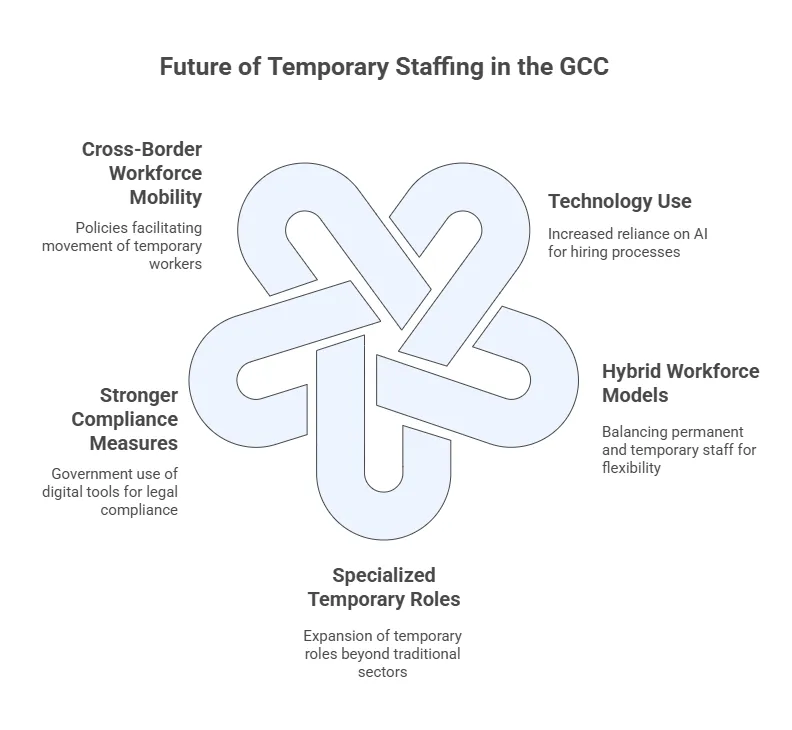
Key trends include:
- More Technology Use: Companies will increasingly rely on AI for candidate screening, digital contracts, and automated payroll systems to make hiring faster and more accurate.
- Hybrid Workforce Models: Businesses will combine permanent and temporary staff to balance stability with flexibility.
- Specialized Temporary Roles: Temporary staffing will expand beyond traditional blue-collar jobs. Professionals in IT, healthcare, finance, and logistics will also be hired on short-term contracts.
- Stronger Compliance Measures: Governments will use digital tools to track payroll, visa status, and worker rights, ensuring better legal compliance.
- Cross-Border Workforce Mobility: Policies may make it easier for temporary workers to move between projects and countries within the GCC.
By 2025, companies that adopt modern staffing tools and work with trusted manpower partners will be better prepared to meet demand and stay competitive.
Pros and Cons of Temporary Staffing in the Future
| Pros | Cons |
|---|---|
| Quick workforce scaling to meet project or seasonal demand | Potential lack of continuity and institutional knowledge |
| Lower long-term costs compared to permanent staff | Need for frequent training and onboarding |
| Compliance and payroll often managed by staffing partners | Less employee loyalty and engagement |
| Access to specialized talent for short-term roles | May require more management oversight |
| Greater agility in responding to market changes | Regulatory differences across GCC countries can be complex |
Temporary staffing offers strong benefits, but companies must plan carefully to address challenges, especially around retention, training, and compliance.
How Manpower Supply Companies Are Evolving
Manpower supply companies are no longer just providers of workers—they are becoming strategic partners for businesses. Key changes include:
- Digital Transformation: Staffing firms now use AI to shortlist candidates, GPS tracking to monitor attendance, and dashboards that give clients real-time visibility of their workforce.
- Compliance Expertise: They handle WPS payroll, visa sponsorship, documentation, and contracts, making sure companies meet all legal requirements.
- End-to-End Solutions: Many providers now support both temporary and permanent staffing, giving businesses the flexibility to meet different needs.
- Consultative Support: Trusted manpower partners advise companies on workforce planning, helping them create hybrid staffing models that balance cost, flexibility, and stability.
As the GCC job market continues to grow, manpower supply companies will play a key role in helping businesses manage modern staffing challenges efficiently.
Conclusion
The future of temporary staffing in the GCC is being shaped by technology, regulations, and economic changes. Companies that use flexible staffing strategies will be better equipped to handle shifting market demands.
Temporary staffing is no longer just a short-term solution-it has become a strategic tool for business growth. By partnering with experienced, tech-driven manpower providers, businesses can stay compliant, agile, and competitive.
Looking ahead to 2025, the most successful companies will be those that treat temporary staffing as a key part of their workforce strategy, not just an option.